What Agentforce Field Service Actually Does and What It Does Not Touch
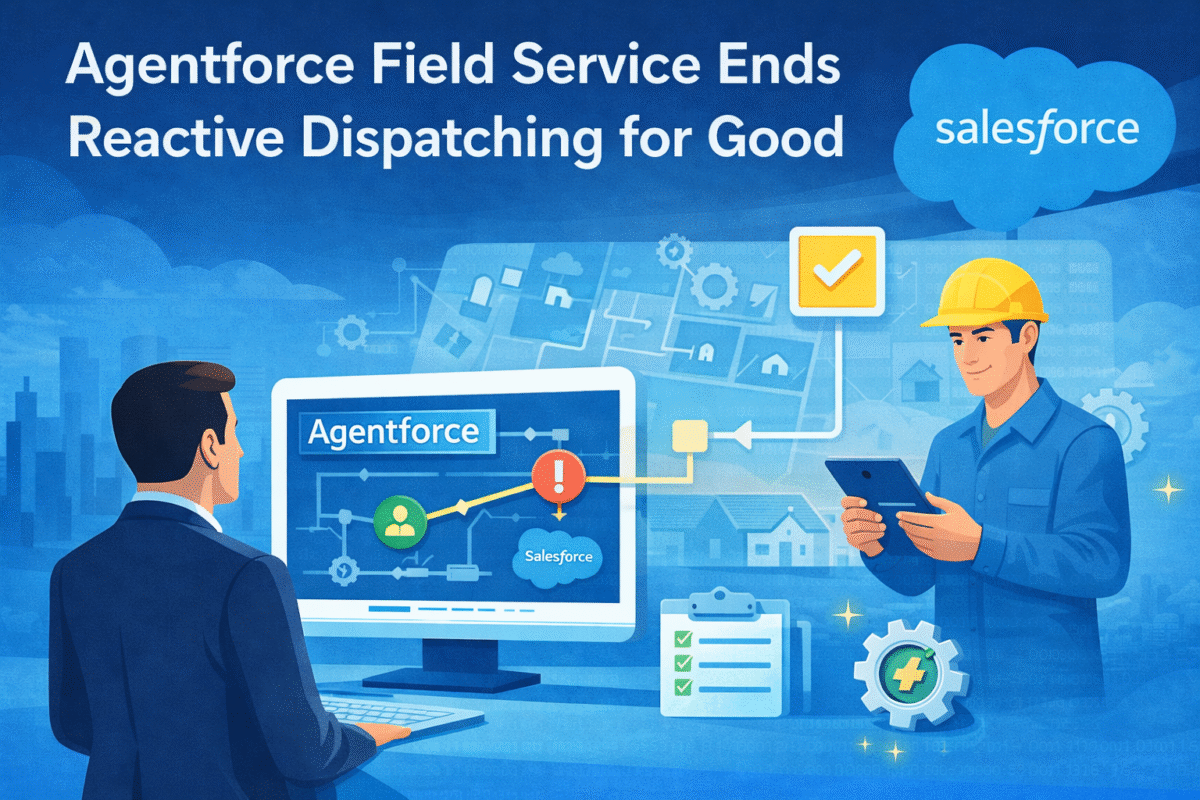
The most important distinction to establish early is that Agentforce for Field Service is not a replacement for dispatchers or technicians. It is a redesign of where their attention goes. The work that currently consumes their time reacting to cancellations, compiling pre-job information, writing post-job summaries, answering routine scheduling queries gets absorbed by agents. What remains with the human is what requires human judgment: escalation decisions, relationship handling, complex diagnostics, and strategic resource planning.
Concretely, Agentforce Field Service operates across four high-impact areas:
1. Autonomous Customer Scheduling
Customers can schedule, reschedule, or cancel appointments 24 hours a day through web or messaging channels in natural language, without navigating a portal or calling a contact center. The agent understands the job type from conversation context, creates the work order, checks technician availability against skills, location, and constraints, and finalizes the booking without any human involvement. That entire process now takes under five minutes where it previously took seventeen.
2. Real-Time Schedule Gap Resolution
When a cancellation, no-show, or early job completion creates a gap, Agentforce detects it immediately and generates replacement options ranked by job duration, parts availability, traffic conditions, SLA requirements, and overtime constraints. Dispatchers review the recommendations and confirm. They no longer spend thirty minutes on the phone working through options manually. The gap gets filled faster, with better optimization logic than any human dispatcher can apply under time pressure.
3. Pre-Work Brief and On-Site Troubleshooting
Before arriving at a job, a technician can listen to an Agentforce-generated work order summary through the Pre-Work Brief playback feature including asset history, previous repairs, required parts, and customer preferences. iPhone users can trigger this through a Siri shortcut, hands-free while driving. On-site, the agent provides step-by-step troubleshooting guidance that adapts based on what the technician has already attempted. It can analyze photos submitted from the job and adjust its recommendations based on what it sees.
4. Automated Post-Work Summaries
At job completion, Agentforce drafts a comprehensive post-work summary from data collected throughout the appointment. The technician reviews and finalizes rather than composing from memory. The administrative tail of every job which currently extends into the car park or the next morning is eliminated.
The agent does not replace the dispatcher’s judgment. It replaces the coordinator work that was consuming the dispatcher’s day and preventing their judgment from being applied to things that actually matter.
How to Deploy It Without Disrupting What Is Already Working
The most common implementation mistake is enabling every Agentforce feature simultaneously and expecting adoption to follow naturally. It does not. Dispatchers and technicians who have developed their own workflows over years do not abandon those workflows because a new tool is available. They adopt new tools when those tools demonstrably make their specific daily work easier.
1. Validate your data foundation first
Agentforce scheduling logic requires clean Service Territory, Resource, Skills, and Work Type data. Gaps in these records produce bad recommendations. A data audit before activation is not optional it is the prerequisite that determines whether agents are trusted or ignored within the first two weeks.
2. Start with Pre-Work Briefs and gap resolution
These two capabilities have the clearest, most immediate value proposition for both dispatchers and technicians. Pre-Work Briefs require minimal configuration and produce instant, visible benefits. Gap resolution demonstrates automation value without touching the core scheduling workflow the lower-risk entry point for teams skeptical of AI driven dispatching.
3. Define autonomy boundaries before going live
Specify exactly which actions agents can complete end-to-end booking within defined windows, updating service appointments and which require dispatcher sign-off overtime approval, premium parts authorization, cross-territory reassignment. These boundaries determine trust. Overly broad autonomy in the first phase consistently undermines adoption.
4. Connect Data Cloud for full context grounding
Agentforce agents that can read unified asset history, customer preferences, and prior service data across all clouds produce materially better recommendations than agents working from Field Service records alone. Data Cloud is the connective layer that makes the troubleshooting and pre-work brief capabilities genuinely intelligent rather than templated.
5. Scale to customer-facing scheduling only after internal adoption is stable
24/7 autonomous customer scheduling is the highest-visibility capability and the highest-stakes one. Deploy it after internal dispatcher and technician adoption is solid and after the agent’s scheduling recommendations have demonstrated accuracy in your specific territory configuration.
The field service labor gap is not going to close. The operations gap can.
Experienced technicians retiring faster than they are replaced is a structural trend, not a temporary shortage. The organizations that build operational efficiency into their field service model now absorbing scheduling, coordination, and documentation work into autonomous agents are the ones that maintain service quality and margin as that gap widens. Agentforce Field Service is already in production at AAA, CPI Security, and Axis Water. The implementation path is clear. The question is timing.