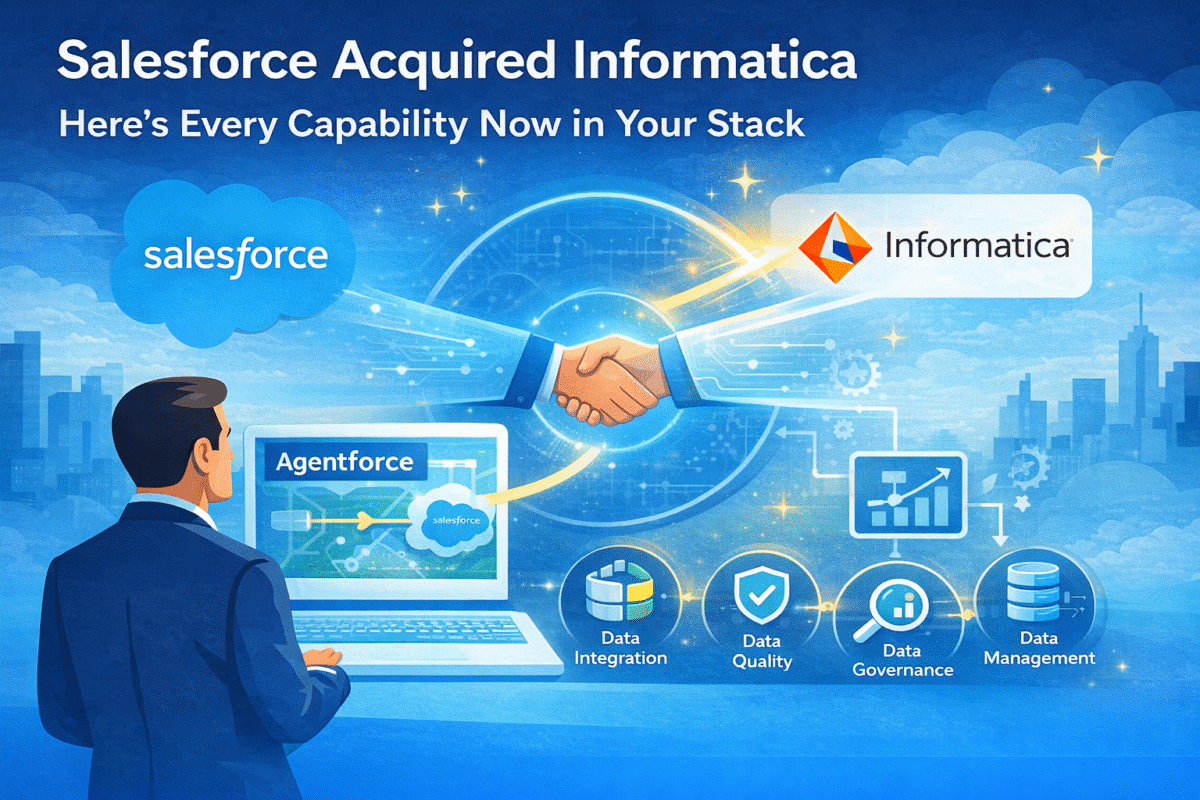
What Informatica’s IDMC Actually Is
Informatica’s core product is the Intelligent Data Management Cloud IDMC. It is a unified, cloud-native platform that manages the full lifecycle of enterprise data from ingestion through governance. It is not a single tool. It is a modular platform built on a shared metadata layer called the Metadata Management Framework, which means every service within IDMC shares a common understanding of what your data is, where it came from, and what it means.
That shared metadata layer is the architectural detail that matters most for Salesforce developers. Every capability below operates on the same metadata foundation which is also what makes IDMC uniquely valuable to a platform like Salesforce, where metadata already defines everything from objects and fields to relationships and permissions.
What Changed for Developers Who Already Use MuleSoft
| Before –> Gap | After –> Unified |
| MuleSoft handled APIs. Data pipelines needed separate tooling. Heavy ETL, CDC, and warehouse loading required third-party tools (Talend, Fivetran, dbt) alongside MuleSoft multiple tools, multiple governance models, multiple skill sets. | MuleSoft for service connectivity. Informatica for data movement. One vendor now covers the full integration stack. MuleSoft handles API orchestration and real-time service calls. Informatica handles data pipeline, transformation, and warehouse load. Same governance model, same metadata layer. |
| Data Cloud identity resolution was limited to customer entity matching. Product, supplier, and location MDM required separate implementations. Multi-domain golden records across entity types were custom builds. | Multi-domain MDM now supports customers, products, suppliers, and locations natively. Informatica’s multidomain MDM handles golden record management across all entity types feeding unified context into Data Cloud and Agentforce agents for any domain. |
| Agentforce context was limited to Salesforce object data plus Data Cloud ingestion. Agent reasoning was bounded by what existed in the Salesforce data model. Cross-system context required explicit integration work to pull external data in. | Enterprise-wide metadata layer gives agents context from every connected system. Agents can reason over data with full lineage, quality scores, and cross-system relationships not just field values, but the provenance and trustworthiness of those values. |
| GDPR and data subject rights required custom Apex workflows per regulation. Cross-system deletion and export requests required manual coordination with each system owner. Audit trails were patchy. | Governance layer automates cross-system policy enforcement with full audit lineage. Subject deletion and export requests traverse all connected systems automatically, with complete lineage-backed audit trail of every action taken. |
The Integration Timeline Developers Should Know About
Salesforce completed the acquisition on November 18, 2025. Integration into the platform is not instant Salesforce’s history with major acquisitions (MuleSoft, Tableau, Slack) shows a consistent pattern of deep platform integration taking 18 to 24 months after close before the full combined capability is available natively in the Salesforce UI and APIs.
Informatica is 32 years of data infrastructure. It just became part of your platform.
Informatica is 32 years of data infrastructure. It just became part of your platform.The acquisition is not theoretical and the capabilities are not vaporware Informatica’s IDMC is in production at thousands of enterprises today. What changes for Salesforce developers is that those capabilities are now on the same strategic roadmap as every other Salesforce product, with integration investment behind them rather than a connector dependency. The developers who understand what each capability does technically, not just by name are the ones who will design the architectures that leverage the combined platform when native integration surfaces in upcoming releases.