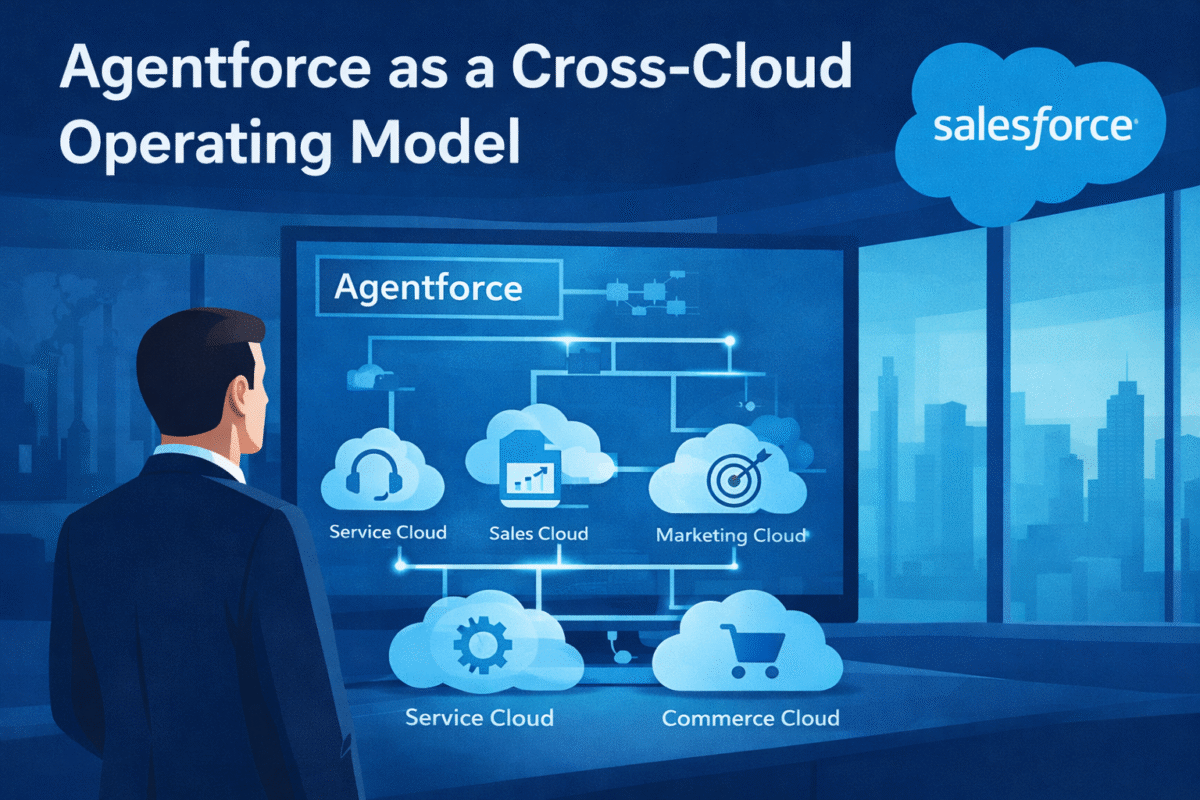
Why Single-Cloud Agentforce Deployment Leaves Most Value on the Table
Consider a typical enterprise customer journey. A lead is acquired through a marketing campaign. They engage with commerce. They become a customer. They raise a service issue. They eventually churn or expand.
In a fragmented Agentforce deployment, each of those stages has its own agent If it has one at all and those agents do not share context. The service agent does not know what the marketing agent recorded about campaign engagement. The sales agent does not know what the commerce agent observed about browse behavior. Each agent operates with an incomplete picture of the customer it is trying to help.
The Three Barriers That Prevent Cross-Cloud Agent Deployments
1. Data silos between clouds
Most Salesforce orgs have data that lives in separate clouds with no unified layer connecting them. Agentforce agents that can only read from a single object model cannot provide the cross-context reasoning that makes multi-cloud deployment valuable. Data Cloud is the connective tissue — but 96% of organizations report experiencing barriers to using their data for AI use cases, primarily because of disconnected architecture.
2. Governance gaps across agent portfolios
As agent count grows, so does the risk of agents interfering with each other’s actions, producing conflicting outputs, or operating outside defined authority boundaries. Only 54% of organizations currently have a centralized governance framework with formal oversight for their agentic capabilities. The remaining 46% are building agent libraries without the controls that make those agents trustworthy at enterprise scale.
3. Internal expertise gaps
41% of enterprises cite a lack of internal expertise in AI and agent design as a primary adoption blocker. This is not a technical problem — it is an organizational one. The skills required to design effective agent topics, calibrate escalation thresholds, and build responsible action frameworks are different from traditional Salesforce admin or developer skills. Organizations that treat Agentforce as a configuration task rather than an architectural discipline consistently underperform.
How to Actually Design for Multi-Cloud Agentforce
The practical path to cross-cloud Agentforce deployment is not as complex as the barrier list might suggest but it does require a specific sequence of decisions.
The foundation is Data Cloud. Without a unified customer data layer that agents can read from across all clouds, multi-cloud agents are not possible at the level of context fidelity that makes them genuinely valuable. This is not an optional enhancement it is the architectural prerequisite.
The second requirement is an agent topology map. Before building individual agents, organizations need to define which agents will exist, what each agent is authorized to do, which actions it can take autonomously versus which require human approval, and how agents hand off to each other when a customer journey crosses cloud boundaries. This design work happens on a whiteboard before it happens in Agentforce Builder.
The third requirement is a unified governance model. Agent topics, action permissions, escalation thresholds, and performance benchmarks need to be managed centrally not owned by individual cloud teams operating in isolation. The same discipline that prevents Salesforce technical debt also prevents agent sprawl.
Organizations that get these three things right before deploying their second or third agent consistently report dramatically faster time-to-value than those who build first and govern later.