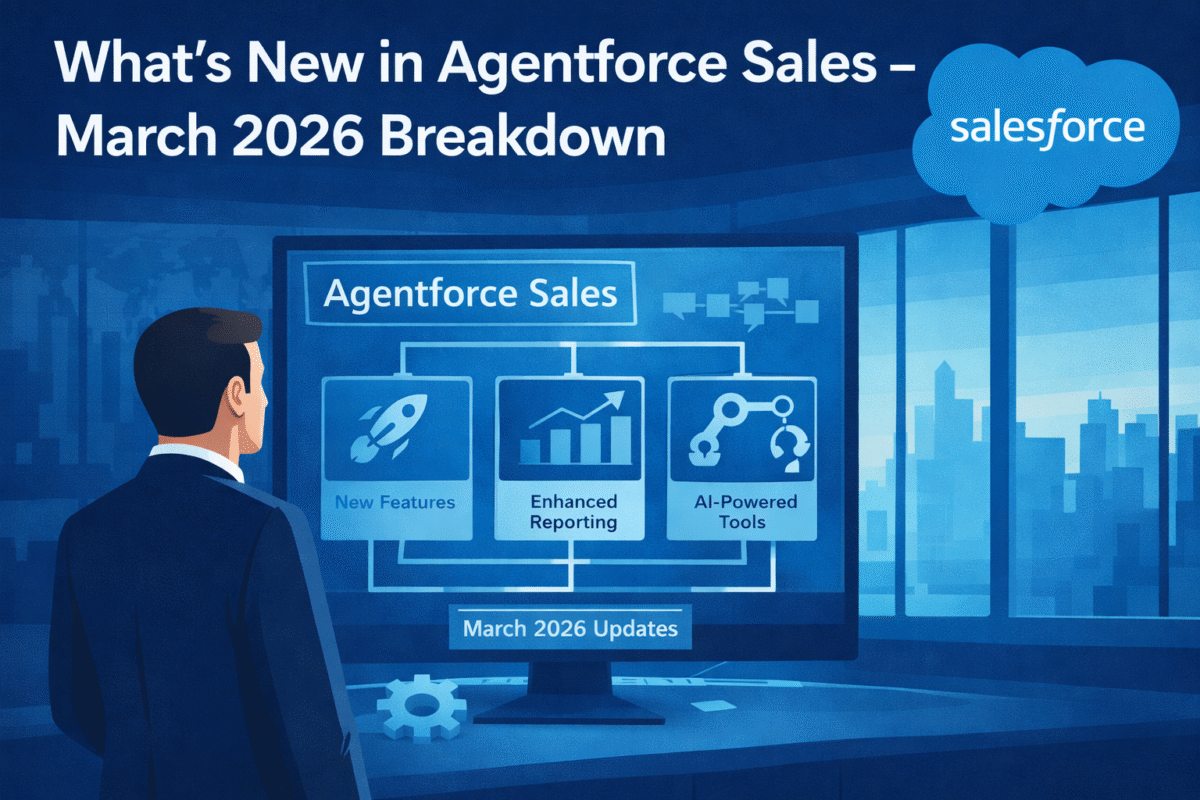
The Six Agents Now Generally Available
Agentforce Sales launched with six production-ready agents. These are not experimental capabilities. Each one is designed for a specific, high-volume task that currently consumes meaningful portions of a rep’s working day.
| Agent | What it handles autonomously |
| Engagement Agent | Outbound lead nurturing and initial qualification responds to inbound inquiries 24/7 with full CRM context |
| Pipeline Management Agent | Monitors deal health, flags stalled opportunities, recommends next actions, and updates stage fields automatically |
| Account Research & Meeting Prep Agent | Synthesizes CRM history, third-party signals, and web data into a meeting brief in seconds rather than hours |
| Prospecting Agent | Runs continuously to enrich existing data and build prioritized lead lists surfaces results in CRM and Slack |
| Quoting Agent | Generates quotes based on product rules and pricing logic, reducing configuration time per deal significantly |
| Partner Success Agent | Handles partner-facing queries, deal registration status, and co-sell coordination without rep involvement |
Each agent is embedded directly into the workflows reps already use. Agentforce Sales works across Sales Cloud, Slack, ChatGPT, and Microsoft Teams eliminating what Salesforce is calling the “toggle tax,” the productivity loss that accumulates when sellers constantly switch between tools to find information or complete tasks.
The real shift – This Is Not About Replacing Reps. It Is About What Reps Do With the Time.
The framing from Salesforce is deliberate. “By providing every rep with a team of agents to manage high-volume tasks, we are eliminating the administrative tax on sales teams,” said Kris Billmaier, EVP and GM of Agentforce Sales. That administrative tax the research, the data entry, the follow-up scheduling, the quote configuration is what Agentforce Sales is designed to absorb.
Sales teams have always operated on a human-only model. Agentforce Sales does not change what the best reps are good at. It eliminates the work that was preventing them from doing it.
What remains with the human is the part that has always driven the most revenue: building trust with a buyer, reading the room in a negotiation, understanding the political dynamics inside a prospect’s organization. No current version of any AI agent does those things reliably. The agents that shipped on March 16 are not trying to.
This is actually the important point for sales leaders to internalize. Agentforce Sales is not an argument about headcount. It is an argument about how existing headcount gets deployed. A rep who is no longer spending two hours on meeting prep before every call is a rep with two more hours for the conversations that close deals.
What Early Adopters Are Seeing
Early production data is limited but the directional signal is clear. Equinox, the fitness company, deployed Agentforce to handle prospect engagement. Their CTO, Eswar Veluri, noted that agents can now respond to prospects immediately around the clock with the full context needed to answer questions accurately. The outcome is not just speed. It is consistency. Every prospect gets the same quality of response regardless of which rep owns the account or what time zone they are in.
That consistency point is underrated in the current conversation about Agentforce Sales. Variable rep performance is one of the most expensive problems in enterprise sales organizations. High performers and average performers do not produce the same pipeline quality. Agents, configured correctly, apply the same qualification criteria, the same follow-up cadence, and the same information standards to every interaction. That is a structural improvement to pipeline quality that compounds over time.
The question is not whether to deploy. It is how fast to go.
Agentforce Sales is now generally available, the use cases are real, and the first wave of production deployments is already producing data. The competitive pressure to act is genuine. But the organizations that will build durable advantage are the ones treating the agent rollout as an architectural project data first, governance second, scale third rather than a feature activation.