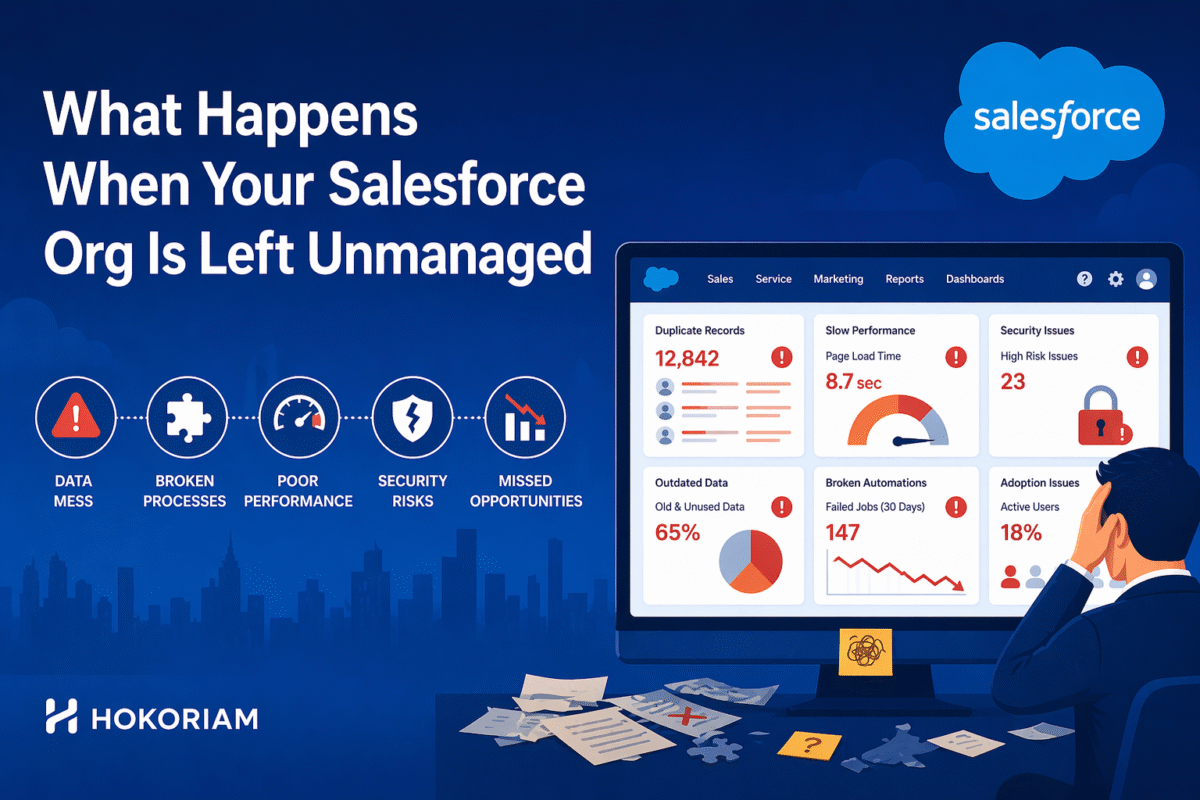
Every Salesforce org starts clean. Then requirements come in, implementations happen under deadline pressure, customisations compound, and the person who built the original architecture leaves. Within two to three years of initial deployment, the average Salesforce org has accumulated enough technical debt, orphaned configuration, and undocumented customisation to cause real operational risk. Most organisations only discover this when something breaks.
How Org Health Degrades Over Time
Automation Conflicts
Flows, Apex triggers, Process Builders, and Workflow Rules that were each built independently begin to interact in unpredictable ways. A new Flow fires on the same object as a legacy trigger. One automation’s output becomes another’s input in a way that creates infinite loops, excessive DML operations, or data states no one designed. These interactions are invisible until the combination hits a governor limit or corrupts a record.
Security Permission Drift
Profiles and permission sets accumulate permissions that were granted for specific projects or users and never revoked. Users who changed roles retain access to data from their previous department. Temporary admin access granted during an implementation becomes permanent access no one noticed. Over time, the org’s security model no longer matches its intended access policy.
Data Quality Erosion
Validation rules that were soft-launched get removed when they cause friction. Required fields get bypassed through workarounds. Duplicate records accumulate because merge rules were never configured. Data Cloud or external integrations ingest records without the quality checks the org relies on. Two years after implementation, a CRM that was clean at go-live has enough data quality issues to make every report questionable.
Undocumented Customisation
The developer who built the integration with your ERP, the admin who created the 47-step approval process, and the consultant who configured the custom territory model are gone. There is no documentation. New developers make changes without understanding dependencies. Simple requirement changes take three times as long because every modification requires reverse-engineering what already exists.
Release Update Debt
Salesforce releases three times per year. Each release includes critical security updates and release updates that require opt-in or will be auto-enforced on a future date. Orgs that do not review release updates accumulate a backlog of mandatory changes until a Salesforce enforcement date arrives and previously working functionality breaks in production without warning.
What a Quarterly Salesforce Health Check Actually Covers
Permission Set Audit
Review all profiles and permission sets. Identify over-privileged users, redundant permissions, and access that no longer matches business roles.
Flow & Trigger Review
Identify conflicting automations, inactive flows with active dependencies, and automation patterns approaching governor limits.
Duplicate & Completeness Check
Measure duplicate rates, required field completion rates, and identify records with data quality issues that affect reporting accuracy.
Technical Debt Assessment
Review custom code for deprecated API usage, Apex tests with inadequate coverage, and hard-coded values that create maintenance risk.
Release Update Compliance
Review all pending release updates and enforce dates. Identify which require testing and prioritise against upcoming Salesforce enforcement deadlines.
Usage & Adoption Analysis
Identify features being used, features that were implemented but never adopted, and users who have not logged in within defined thresholds.
Hokoriam’s Managed Services – What We Cover
What Our Managed Services Clients Get
Dedicated certified Salesforce support: a team that knows your org, not a generic helpdesk. Requests handled by the same people who built the solutions, not passed to whoever is available.
Quarterly health checks: proactive audit of security, automation, data quality, and release update compliance, with a written report and prioritised remediation plan.
SLA-backed response times: production incidents handled with defined response and resolution time commitments, not ad-hoc when someone is available.
Continuous improvement: monthly enhancement hours for new requirements, optimisations, and feature adoption, so your Salesforce org evolves with your business instead of staying frozen at implementation.
Release management: every Salesforce release reviewed, tested in sandbox, and deployed with impact assessment so release updates never cause production surprises.
Hokoriam Provides Ongoing Salesforce Support and Managed Services
With 7+ years and 100+ Salesforce implementations, we have seen what unmanaged orgs become. Our Managed Services clients get a certified Salesforce partner who knows their org, responds to incidents with SLA commitments, and proactively prevents the problems that break production. If your Salesforce org has no dedicated support, it is already accumulating risk.