Tag Archives: Service Cloud

The Real ROI of Salesforce Starts When Manual Work Stops Controlling the Business

The Real ROI of Salesforce Starts When Manual Work Stops Controlling the Business Enterprises do not lose margin because markets slow down. They lose margin because operational drag becomes too expensive to carry. In most multinationals, Salesforce already exists, yet revenue processes still rely on spreadsheets, email approvals, swivel chair data entry, and region specific workarounds. The problem is not that Salesforce cannot fix these issues. The problem is that Salesforce has not been engineered to eliminate them. When Salesforce is treated as a UI wrapped around legacy behavior, businesses get low adoption, inconsistent reporting, and an automation ceiling. When it is treated as an enterprise execution layer, built intentionally with Flow, Apex, and LWC across a scalable governed architecture, leaders unlock measurable financial performance. A global life sciences company recently faced this reality. Despite a multiyear Salesforce program, service cycle time remained above target and profitability was trending down. Technicians handled scheduling via phone calls. Contract entitlements were validated manually. Field data was retyped into ERP days later. Leadership had data dashboards but not operational control. The turning point came when the organization stopped asking "What features do we need next?" and instead asked "Which business outcomes are we failing to achieve?" From there, Salesforce was redesigned to become the operational core. Flow managed automated dispatching based on skill, parts availability, and SLA logic. LWC components in the service console provided entitlement visibility in real time. Apex handled predictive parts ordering triggered by IoT telemetry. Role based governance ensured sensitive data never crossed regional compliance boundaries. Salesforce integrated ERP, asset management, and field apps into a single transaction chain instead of five disconnected systems. The transformation was not cosmetic. Service cycle time decreased by 44 percent. Contract profitability improved because entitlements were enforced consistently. Repeat truck rolls dropped sharply. And because compliance was automated instead of manual, three markets that previously avoided digital field processes adopted the new global model quickly. The financial outcome was not an estimate. It appeared directly on the P&L. This is why strategic CRM design matters. Growth at scale requires architecture that tolerates complexity without passing it to employees. Automation reduces cost. Systems integration reduces waste. Governance reduces risk. Salesforce becomes a business accelerator only when it becomes the engineered environment where friction cannot survive. Hokoriam partners with multinational leaders who expect Salesforce to produce real business impact, not just more dashboards and licenses. If your next phase of transformation requires efficiency, profitability, security, and scale, we should talk. The value you expect from Salesforce is not theoretical. It is unlocked through design.

Enterprises do not lose margin because markets slow down. They lose margin because operational drag becomes too expensive to carry. In most multinationals, Salesforce already exists, yet revenue processes still rely on spreadsheets, email approvals, swivel chair data entry, and region specific workarounds. The problem is not that Salesforce cannot fix these issues. The problem […]

The Most Profitable MNCs Treat Salesforce as Infrastructure, Not Software

Enterprise transformation is no longer driven by isolated digital initiatives. It is driven by the quality of the systems that run the business every day. For multinational organizations, Salesforce is not just a CRM. It is the operating backbone that connects revenue, operations, finance, supply chain, and customer experience. The companies outperforming their peers are […]

Intelligent Salesforce Governance is the Fastest Route to Global Operational Efficiency
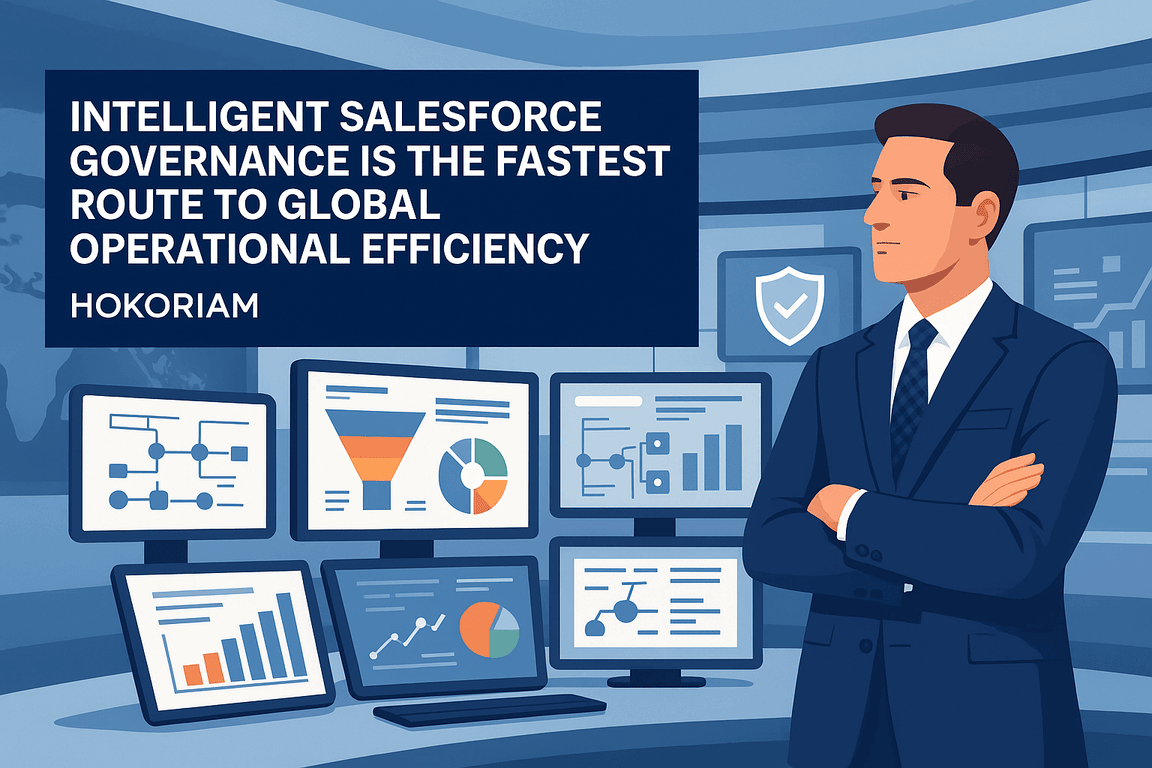
Intelligent Salesforce Governance is the Fastest Route to Global Operational Efficiency The enterprises that scale fastest are not the ones with the most Salesforce features. They are the ones with the strongest Salesforce governance. Global organizations are operating in increasingly complex ecosystems, with distributed teams, overlapping processes, and aggressive growth targets. In this landscape, CRM cannot just store data. It must orchestrate performance. When designed strategically, Salesforce becomes a multiplier of efficiency across functions. It shortens revenue cycles, increases productivity per employee, and reduces operational leakage. The organizations that struggle are those that scale Salesforce organically without architectural discipline. The result is technical debt, brittle automation, inconsistent data, and stalled transformation. At Hokoriam, we see this pattern frequently. A multinational manufacturing group recently approached us after investing heavily in Salesforce but failing to achieve financial lift. They had 8 business units across 17 countries, each customizing the system independently. Duplicate automation, ungoverned access, disconnected integrations, and inconsistent data models were costing the company millions in shadow process costs. Their sales cycle extended by an average of 12 days because automation and access rules conflicted in different regions. Our redesign was not about adding more technology. It was about governing it. We rationalized their automation logic using scalable Flow architecture with Apex and LWC where required for performance. We unified their object model and established a global data contract. We implemented a controlled integration framework that tied Salesforce to ERP, PLM, and procurement platforms. We restructured permissions to align with zero trust security principles and introduced a release governance model with CI/CD and sandbox pipelines. The business outcomes came fast. Global quote approval time reduced by 41 percent. Sales productivity increased by 23 percent. Process exceptions were down 62 percent because automation stopped conflicting. Technical debt dropped enough to reduce annual Salesforce overhead by more than 1.2 million dollars. Governance became the fuel for agility, not a barrier. This is why strategic CRM design matters. Salesforce is an enterprise nervous system, not a standalone tool. Enterprises gain ROI when automation decisions align with business architecture. Flow is powerful, but only when layered intelligently with Apex, LWC, and integration orchestration. Data is valuable only when modeled consistently across regions. Security matters only when role structures scale without creating friction. In global environments, performance depends on discipline. If your organization is preparing for transformation, the most important decision is not which features to deploy, but how to architect them for resilience, compliance, and efficiency. Hokoriam helps global enterprises turn Salesforce from a workload into a competitive advantage. If leadership is ready to eliminate complexity, protect scale, and accelerate outcomes, now is the right time to talk. Let’s discuss your Salesforce transformation goals and design a roadmap that guarantees measurable business impact. Feature Image Prompt: A 16:9 professional illustration of a confident global business executive reviewing a futuristic multi screen Salesforce automation and analytics control center with dashboards, flows, and secure architecture visualizations in a corporate environment, subtle Hokoriam branding, enterprise scale transformation tone.

The enterprises that scale fastest are not the ones with the most Salesforce features. They are the ones with the strongest Salesforce governance. Global organizations are operating in increasingly complex ecosystems, with distributed teams, overlapping processes, and aggressive growth targets. In this landscape, CRM cannot just store data. It must orchestrate performance. When designed strategically, […]
Global Efficiency Starts With Intelligent Salesforce Governance

Global Efficiency Starts With Intelligent Salesforce Governance

As multinational organizations scale across markets, business complexity grows exponentially. Customer engagement models diversify, regulatory controls evolve, and process inconsistencies quietly erode efficiency and profitability. The companies that outperform their competitors are not simply using Salesforce. They are engineering Salesforce with governance, automation, and scalability at the core. Consider the case of a global logistics […]
Salesforce Einstein Bots: Transforming Customer Service with AI

Einstein Bot

In today’s digital-first world, customers expect instant answers and personalized experiences. Businesses that fail to deliver quick and efficient support risk losing customers. This is where Salesforce Einstein Bots step in — AI-powered chatbots built directly into Salesforce to help automate conversations, resolve queries, and enhance customer experience. What is Salesforce Einstein Bot? Salesforce Einstein […]

This site uses cookies to offer you a better browsing experience. By browsing this website, you agree to our use of cookies.